
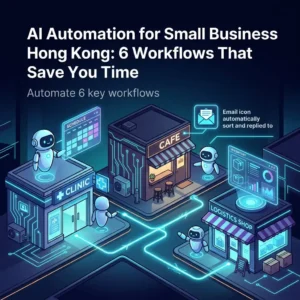
AI automation for small businesses in Hong Kong is no longer something only large companies with big IT budgets can access. Right now, in 2026, a restaurant owner in Wan Chai, a legal firm in Central, and a product retailer in Mong Kok are all using the same category of tools to do in seconds what their staff used to spend hours doing manually. AI automation for small businesses in Hong Kong means software handling the repetitive parts of your operation: answering the same customer questions, sorting invoices, drafting social posts, so your team focuses on the work that actually needs a human.
The gap between knowing AI exists and actually putting it to work is where most Hong Kong SMEs are stuck right now. According to a Microsoft and LinkedIn survey of Hong Kong businesses, 85% of local business leaders believe their company needs AI to stay competitive. Yet the same survey found that 86% of employees in Hong Kong using AI are doing so with their own personal tools, with no company strategy behind it. That is individuals finding workarounds. AI automation for small businesses in Hong Kong is different. It is a deliberate system built around your specific workflows, not a ChatGPT account someone uses to draft emails.
If you want to stop losing hours to tasks a machine can handle, DOOD builds AI automation for small businesses in Hong Kong systems across every sector. Explore our AI services here and see what we can set up for your operation.
Why Hong Kong SMEs Are Moving to AI Automation Right Now
The gap between wanting AI and actually using it
A Cisco survey reported by the South China Morning Post found that only 2% of organisations in Hong Kong are fully prepared for AI adoption, the lowest figure among all 30 markets surveyed globally. That number is not a reason to feel behind. It is a reason to move now, while the advantage of being an early mover still exists. The businesses in Hong Kong that build proper AI automation for small businesses in Hong Kong workflows in 2026 will be processing enquiries, generating reports, and qualifying leads while their competitors are still doing it by hand.
The preparation gap exists for a specific reason. Most business owners researching AI automation for small businesses in Hong Kong have tried one or two AI tools individually, a writing assistant here or a chatbot there, and found the results inconsistent. That experience creates the false conclusion that AI automation does not work. The problem is not the tools. The problem is that isolated tools, used without a connected workflow, do not produce the time savings that proper automation delivers. A chatbot that cannot pass a qualified lead to your sales team is just a toy. An automated invoice system that does not connect to your accounting software creates more admin, not less.
Hong Kong's business environment adds specific urgency to this. The city operates bilingually. Customers expect responses in Traditional Chinese and English, often in the same conversation. Staff costs are high. Office space is expensive. Every hour a member of staff spends on a task that software could handle is an hour that costs significantly more in Hong Kong than in almost any other city in Asia. AI automation for small businesses in Hong Kong addresses all three of these pressures at once. Our AI web development services are built specifically for this bilingual, high-cost environment.
Why WhatsApp changes the automation picture in Hong Kong
In most markets, customer service automation starts with a website chatbot. In Hong Kong, it starts with WhatsApp. WhatsApp is the primary channel most HK customers use to contact a business. Not email, not a contact form, not Instagram DMs. This means that any serious AI automation for small businesses in Hong Kong strategy must begin with WhatsApp, not a website widget. Tools like WATI, which is an official WhatsApp Business API partner, allow businesses to set up automated reply flows, qualify customers based on their answers, and route urgent conversations to a live team member, all inside WhatsApp, which the customer never has to leave.
5 Workflows Hong Kong Small Businesses Are Automating in 2026
These are not theoretical use cases. These are the five workflows that Hong Kong SMEs using AI automation for small businesses in Hong Kong across retail, F&B, professional services, and logistics are actively running right now. Each one replaces a specific category of manual work. The table below shows the tool, what it replaces, and whether it handles Traditional Chinese, a critical filter for any HK business.
| Workflow | Tool | What it replaces | Traditional Chinese support |
|---|---|---|---|
| WhatsApp customer replies | WATI (WhatsApp Business API partner) | Manual staff responses to repeat enquiries | Yes |
| Social content drafting | Claude or ChatGPT alternative + Buffer | Hours of weekly bilingual copywriting | Yes |
| Website lead qualification | Tidio or Intercom (LLM-based chatbot) | Sales staff fielding cold and unqualified enquiries | Partial |
| Invoice and document processing | Microsoft Power Automate | Manual data entry and document routing | Yes |
| Performance reporting | Google Looker Studio + AI summary | Manual spreadsheet consolidation each week | Yes |
Starting with WhatsApp — the channel every HK customer already uses
A WhatsApp automation setup is one of the most practical entry points into AI automation for small businesses in Hong Kong. Using a tool like WATI works like this. A customer sends a message asking about your opening hours, your pricing, or whether an item is in stock. Instead of a staff member typing a reply, the system sends an accurate, pre-set answer within seconds, at any hour of the day or night. If the customer's question falls outside the automated responses, the system flags it and routes the conversation to a human. The customer gets a fast answer. Your staff only see the conversations that genuinely need them.
Bilingual automation — why English-only tools fall short in Hong Kong
This is where many off-the-shelf tools fail at AI automation for small businesses in Hong Kong. A chatbot trained only on English content will produce awkward, machine-translated Traditional Chinese that customers notice immediately. The IAB Hong Kong and fifty-five 2025 survey found that content creation is now the leading AI application among HK businesses at 26%, but most of that content is in English. Businesses that build bilingual automation, with properly written Traditional Chinese responses, operate in a category most of their local competitors have not reached. It is a genuine competitive gap right now. DOOD's e-commerce website design integrates bilingual automation directly into the customer journey from the first touchpoint.
From enquiry to invoice — automating the full customer journey
The most significant efficiency gains from AI automation for small businesses in Hong Kong come when workflows connect to each other. A customer enquires on WhatsApp, gets qualified by an automated flow, books a call through an automated calendar link, receives a proposal generated from a template, approves it, and triggers an automated invoice. All of this happens without a staff member manually moving information from one system to another. Microsoft Power Automate is the most practical tool for connecting these steps for an HK SME. It integrates with Outlook, Teams, SharePoint, and most accounting platforms used in Hong Kong, and it handles Traditional Chinese document content correctly.
Worth knowing: Setting up automation properly takes real time upfront. A WhatsApp bot that has not been trained with accurate information about your business will frustrate customers faster than no bot at all. The first two to four weeks of building any automation workflow involve configuration, testing, and fixing edge cases. Plan for that time before you launch anything to customers.
What These Workflows Cost to Set Up in Hong Kong
Free tools versus paid platforms — where the real difference is
Most of the tools that power AI automation for small businesses in Hong Kong have free tiers. WATI starts with a trial period. Tidio has a free plan. Google Looker Studio is free to use. Microsoft Power Automate is included in most Microsoft 365 business subscriptions. For a Hong Kong SME already paying for Microsoft 365, the invoice automation workflow costs nothing in additional software. The cost is in the setup: the time it takes to map your current process, configure the tool to match it, connect it to your other systems, and test it properly before going live.
Paid tiers for AI automation for small businesses in Hong Kong become necessary when you need volume. WATI's paid plans are structured around the number of contacts and messages per month. Tidio charges based on active conversations. For most HK SMEs starting out, free tiers are sufficient for the first few months. The question is not what the software costs. The question is whether you have the internal expertise to configure it correctly, or whether the cost of getting it wrong, and having to redo it, is higher than bringing in a developer from the start. Our SEO services ensure that once your automated lead funnel is built, qualified traffic is actually reaching it.
When it makes sense to bring in a developer
You need a developer for AI automation for small businesses in Hong Kong when your automation requires a custom integration: when the two systems you want to connect do not have a pre-built connector, when your data is structured in a non-standard way, or when you need the automation to make decisions based on logic that goes beyond simple if-then rules. You also need a developer when your workflow involves sensitive customer data, because misconfigured automations can expose information in ways that breach Hong Kong's Personal Data (Privacy) Ordinance. For standard workflows such as WhatsApp replies, social scheduling, and basic reporting, a well-configured no-code tool is sufficient and faster to deploy.
Why Most Hong Kong Businesses Try AI and Give Up After Two Weeks
The "we tried ChatGPT and nothing changed" problem
This is the most common story in Hong Kong right now. A business owner reads about AI, signs up for a tool, uses it a few times, does not see a dramatic change, and concludes it does not work for their business. The problem is the expectation, not the tool. AI automation for small businesses in Hong Kong is not a product you switch on. It is a process redesign. The tool is the last step, not the first. The first step is identifying exactly which task is being repeated most often, mapping the exact steps involved, and then finding the tool that handles those specific steps. Skipping that process and going straight to a tool is why most attempts fail.
The Microsoft and LinkedIn survey of Hong Kong businesses found that 86% of people using AI at work are doing it with their own personal tools, without a company-wide strategy. That means most businesses in Hong Kong have individuals experimenting with AI rather than systems running AI. Individual experimentation produces individual results: useful for the person, invisible to the business. AI automation for small businesses in Hong Kong produces business results only when it is built as a system, not adopted as a habit by one team member. Our website maintenance and security services keep the systems we build running correctly after launch. An automation that breaks silently is worse than no automation at all.
Automation only works when the data going in is clean
This is the technical reason most automations fail quietly. A WhatsApp bot that pulls product information from a spreadsheet with inconsistent formatting will give inconsistent answers. An invoice processing tool that reads PDFs with non-standard layouts will make extraction errors. A reporting dashboard that pulls from multiple sources with different date formats will show wrong numbers. Before any AI automation for small businesses in Hong Kong workflow can be trusted, the underlying data it reads from needs to be clean, consistent, and structured. Fixing data quality is unglamorous work. It is also non-negotiable.
Key point: AI automation for small businesses in Hong Kong is not one tool. It is a connected sequence of steps. A chatbot that cannot hand off to a human, a report that no one reads, an invoice tool that does not connect to your accounting software: these are expensive decorations, not automation. Every workflow must connect to the next step, or it creates a new manual task instead of eliminating one.
How to Pick the First Process to Automate in Your Hong Kong Business
The one question that tells you where to start
Ask your team one question: what task do you do more than five times a day that follows the exact same steps every time? The answer to that question is your starting point. It will not be a glamorous answer. It will probably be something like "we reply to the same three WhatsApp questions every morning" or "we copy order details from email into our stock system." That is precisely the right target. Repetitive, predictable, high-frequency tasks are what AI automation for small businesses in Hong Kong handles best. Complex, judgement-heavy, relationship-sensitive work stays with your team.
Once you have identified the task, mapping every step is what separates successful AI automation for small businesses in Hong Kong from failed attempts. Write down every step before you touch any tool. Write down: what triggers the task, what information is needed, what the output looks like, and where that output goes next. This map is what you configure the tool to follow. Without it, you are guessing at the setup and wondering why the results are inconsistent. With it, configuration becomes straightforward, testing is fast, and the workflow runs reliably from day one. DOOD's managed hosting services provide the stable, secure infrastructure that keeps automation tools running 24 hours a day without interruption.
What to hand to an agency versus what to do yourself
Handle it yourself if: the workflow is contained within one tool, the data involved is simple and consistent, and you have at least one team member willing to spend a few days learning the platform. Hand it to an agency if: the workflow crosses two or more systems that need to talk to each other, the data involves customer personal information, the tool requires code to configure, or the cost of a failed launch, such as unhappy customers, wrong invoices, and missed leads, is higher than the cost of getting professional help upfront. For most Hong Kong SMEs, the first automation is a good candidate for self-service. The second and third, which usually involve connecting systems, benefit from experienced hands. AI automation for small businesses in Hong Kong scales in complexity, and having the first workflow built correctly creates the foundation every subsequent one depends on.
Frequently Asked Questions
How much does it cost to set up AI automation for a small business in Hong Kong?
The software costs for standard AI automation for small businesses in Hong Kong workflows are low. Many tools have free tiers, and platforms like Microsoft Power Automate are included in existing Microsoft 365 subscriptions. The real cost is setup time: typically two to four weeks of configuration, testing, and refinement before a workflow runs reliably. If you bring in a developer or agency to build it, expect to pay for that time. A simple WhatsApp automation setup for a Hong Kong SME typically costs less than one month of the staff time it replaces.
Can AI automation tools handle Traditional Chinese for my Hong Kong customers?
Some tools built for AI automation for small businesses in Hong Kong handle Traditional Chinese natively and well. WATI, Microsoft Power Automate, and Google Looker Studio all support Traditional Chinese content correctly. Others, particularly some website chatbot platforms, produce awkward or inaccurate Traditional Chinese that damages the customer experience. Always test any tool with real Traditional Chinese input from your own customers before deploying it. Bilingual automation built properly is one of the clearest competitive advantages available to Hong Kong SMEs in 2026.
Do I need a developer to set up AI automation for my Hong Kong business?
Not always. Simple AI automation for small businesses in Hong Kong workflows such as a WhatsApp reply bot, a social scheduling system, or a basic reporting dashboard can be configured without code using no-code platforms. You need a developer when two or more systems need a custom integration, when your workflow handles customer personal data that must comply with Hong Kong's Personal Data (Privacy) Ordinance, or when the logic driving the automation is complex enough that a misconfiguration would produce errors your customers notice.
Recent Websites Built by DOOD
- Seafood Society — a premium online seafood store in Hong Kong with product filtering, subscription options, and integrated delivery management, built on WooCommerce by DOOD.
- Touyun Biotech — a Hong Kong Stock Exchange-listed biotechnology company requiring a multilingual corporate platform in English, Traditional Chinese, and Simplified Chinese, built by DOOD with full investor relations functionality.
- Erlicht — a Hong Kong-based luxury lighting manufacturer serving clients including The Peninsula Hotels and Louis Vuitton, for whom DOOD built a bespoke WordPress platform showcasing their handcrafted collections and international project portfolio.