
Table of Contents
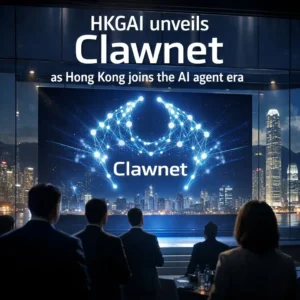
HKGAI, the Hong Kong Generative AI Research and Development Centre, presented a major development on 17 March 2026. It unveiled ClawNet, which it describes as the world's first open-source human-AI agent collaboration network. ClawNet is not a chatbot. It is a framework that lets AI agents work alongside humans inside structured, governed boundaries. The announcement marks a turning point for how Hong Kong approaches AI in the workplace.
Most AI tools available today work in isolation. They answer questions or complete one-off tasks but do not take sustained, multi-step action in the real world. HKGAI is building something different. ClawNet assigns AI agents distinct social identities and defined operational boundaries. Humans keep authorisation and decision-making power. The AI agent executes within those limits. Every action it takes remains traceable.
For Hong Kong businesses, this matters right now. AI agents are moving from a research concept to a practical tool that your competitors will begin using. Understanding what HKGAI is building, and what governed AI agents mean in practice, puts you in a stronger position to make informed decisions. For AI development services built for the Hong Kong business environment, visit DOOD's AI services page.
What Is HKGAI and Why Did Hong Kong Build Its Own AI Research Centre
HKGAI stands for the Hong Kong Generative AI Research and Development Centre. It is a government-backed institution operating under the InnoHK innovation programme. InnoHK is Hong Kong's platform for building world-class research clusters in the city. HKGAI was established specifically to advance generative AI research and to develop AI tools built for Hong Kong's needs. It is led by academics from the Hong Kong University of Science and Technology.
Hong Kong had specific reasons to build its own AI centre rather than rely entirely on tools developed overseas. The city has a distinct legal and regulatory environment, two official languages, and a business community that operates across both English and Traditional Chinese. AI tools built for global or mainland China markets do not always serve Hong Kong businesses well. HKGAI exists to close that gap with research and products tailored to local conditions.
The products HKGAI has already released demonstrate this local focus. HKChat is a locally developed AI chat assistant. HKPilot supports productivity tasks. HKMeeting handles meeting-related workflows. LexiHK addresses language and legal terminology specific to Hong Kong. The centre has also built a school selection tool, a budgeting tool, and a horse racing data analysis tool. These are not generic products. They reflect the specific practical needs of Hong Kong users.
ClawNet represents the next step in HKGAI's work. It moves beyond individual tools into infrastructure. Rather than giving Hong Kong users one more AI product to operate, ClawNet builds a governed framework for how AI agents and humans work together across many tasks and contexts. For businesses exploring how AI development fits into their digital strategy, DOOD's AI web development services cover the technical integration side.
What Does ClawNet Do and How Is It Different From Other AI Agent Tools
ClawNet is HKGAI's open-source human-AI agent collaboration network. That phrase has three parts worth unpacking. Open-source means the underlying code is publicly available for inspection and building upon. Human-AI collaboration means the system is designed for humans and AI agents to work together, not for AI to replace human decision-making. Agent network means it coordinates multiple AI agents working across tasks, not just one AI tool handling one job at a time.
The core problem HKGAI's ClawNet addresses is that today's AI agents operate in silos. An AI agent handling a task does not exist within any broader social or operational context. It has no defined identity, no boundaries, and no accountability trail. Zhang Yonggang, a research assistant professor at HKUST who presented the ClawNet work on 17 March 2026, described the problem: current AI agents lack the social context that makes their actions meaningful and governable. ClawNet is designed to change that.
Inside the HKGAI ClawNet framework, each AI agent is assigned a distinct social identity and a set of operational boundaries. The agent knows what it is authorised to do and what it is not. Humans retain full authorisation and decision-making power over any action that falls outside those boundaries. The agent executes tasks autonomously within its defined scope. Every action it takes is logged and traceable. Nothing happens silently or without an audit trail.
Worth knowing: ClawNet was presented on 17 March 2026 but has not yet launched publicly. No confirmed release date has been announced. Hong Kong businesses cannot integrate ClawNet into their operations today. The value of understanding it now is in preparing for the governance questions it will raise when it does become available.
OpenClaw is a point of comparison that helps clarify what ClawNet is solving. OpenClaw is an existing open-source AI agent tool that can gain unusually broad access to user devices and data. Chinese regulators tightened controls on it specifically because of those access risks. ClawNet takes the opposite approach. It is designed so AI agents can only do things that are explicitly allowed. The contrast between OpenClaw's broad access model and ClawNet's boundary-first model illustrates the governance philosophy behind HKGAI's work.
| Feature | Ungoverned agents (e.g. OpenClaw) | ClawNet governed agents |
|---|---|---|
| Device and data access | Broad and unrestricted | Strictly defined operational boundaries |
| Action traceability | Not guaranteed | Every action remains traceable |
| Human oversight | Limited | Humans retain authorisation and decision-making power |
| Agent identity | None assigned | Distinct social identity per agent |
| Regulatory status in China | Tightened controls imposed | Designed to comply with governance frameworks |
What Are AI Agents and Why Do Hong Kong Businesses Need to Understand Them Now
An AI agent is a software program that can take actions in the world to complete a goal, not just respond to a single question. It is the type of system HKGAI is now building governance infrastructure for. A chatbot waits for your input and replies. An AI agent can receive a goal, break it into steps, carry out those steps across multiple systems, and report back with a result.
It can book a meeting, draft a document, query a database, and send a follow-up email, all as part of one instruction. This is a meaningful change from the AI tools most Hong Kong businesses use today.
The reason Hong Kong businesses need to understand this now is timing. AI agents are moving from research labs into commercial products. Major technology platforms are already embedding agent capabilities into productivity tools. Businesses that understand what AI agents can and cannot do, and what risks they carry, will make better procurement decisions than those who encounter the technology for the first time when a vendor presents it to them. The work HKGAI is doing on governance is directly relevant to that preparation.
The governance question is the part most businesses are not thinking about yet. It is central to what HKGAI has designed ClawNet to solve. When an AI agent takes an action on your behalf, who authorised it, what data it accessed, and whether that action was compliant with your obligations are all questions that need answers.
An ungoverned agent leaves those questions open. A governed agent, built on a framework like ClawNet, is designed so the answers are available by default. For businesses building or integrating AI-powered web infrastructure, DOOD's WordPress development services include structured content and integration work relevant to this shift.
How AI Agents Differ From Automation Tools Hong Kong Businesses Already Use
Many Hong Kong businesses already use automation tools such as scheduled email sequences, form-triggered workflows, or rule-based chatbots. These are very different from the AI agents HKGAI is building ClawNet to govern. These tools follow fixed rules. If the condition is met, the action fires. AI agents, of the kind HKGAI is developing, are different because they can reason about situations that no fixed rule anticipated. They can evaluate context, choose between options, and adapt to new information mid-task. This makes them more capable but also less predictable than rule-based automation.
The difference matters for risk management. A rule-based automation either fires or does not. Its behaviour is fully auditable because it is fully deterministic. An AI agent operating without governance boundaries can make decisions that fall outside any rule you set in advance. ClawNet's approach, giving each agent a defined identity and operational scope, is an attempt to bring the predictability of rule-based systems to the flexibility of AI-driven ones. That is a significant technical and governance challenge, and it is why the HKGAI research behind ClawNet deserves attention.
Which Hong Kong Business Functions Are Most Likely to Use AI Agents First
Customer service, document processing, and scheduling are the three business functions where AI agents are moving into commercial use fastest. For Hong Kong businesses, customer service in both English and Traditional Chinese is a practical early use case. An AI agent that can handle enquiries, escalate edge cases to a human, and log every interaction creates efficiency without removing human oversight from decisions that require it. The traceability requirement in HKGAI's ClawNet design maps directly onto what compliance-aware Hong Kong businesses need from this kind of tool.
Why Governed AI Agents Matter for Businesses Handling Sensitive Data in Hong Kong
Hong Kong's Personal Data (Privacy) Ordinance, known as the PDPO, governs how businesses collect, hold, and use personal data. It is the key compliance framework HKGAI's governed agent approach is designed to work within. Any AI agent that accesses customer records, processes enquiries, or takes action on behalf of a user is operating in territory the PDPO covers.
The ordinance requires that data is used only for the purpose it was collected for, that access is limited to what is necessary, and that individuals can request information about how their data is used. An ungoverned AI agent makes all three requirements harder to satisfy.
Governed AI agents, built on a framework like HKGAI's ClawNet where every action is traceable and every agent operates within defined boundaries, are a better fit for PDPO compliance. If a regulator or a customer asks what an AI agent did with their data, a traceable system can answer that question. An untraceable one cannot. This is not a hypothetical concern. The Office of the Privacy Commissioner for Personal Data has increased its focus on AI-related data handling, and businesses that deploy AI agents without governance controls face real compliance exposure.
Key point: Governed AI agents keep every action traceable. In Hong Kong's PDPO environment, that traceability is not a technical feature. It is a compliance requirement. Businesses that deploy AI agents without an audit trail are taking on liability that a governed framework like ClawNet is specifically designed to remove.
The financial services sector in Hong Kong faces an additional layer of obligation. The Hong Kong Monetary Authority and the Securities and Futures Commission both require firms to demonstrate controls over automated decision-making systems. AI agents used in client-facing roles, credit assessment, or transaction processing fall squarely within that scrutiny. Traceability and human authorisation are not optional for regulated firms. The design principles behind HKGAI's ClawNet align with what regulators in this sector already expect.
Professional services firms outside financial services face the same logic, and the HKGAI governance model applies equally to them. A law firm using an AI agent to process client documents, or an accounting practice using one to handle routine filing, needs to demonstrate that the agent acted within its authorised scope. A framework where the agent's identity, boundaries, and action log are built into the system by design reduces the compliance burden compared to bolting governance controls onto an ungoverned tool after deployment. For website security and maintenance that supports compliant digital infrastructure, visit DOOD's website maintenance and security services.
How Hong Kong Businesses Should Approach AI Agent Integration in 2026
The right approach in 2026 is to prepare rather than deploy at speed. HKGAI's ClawNet is not yet publicly available. Other AI agent tools are available but carry governance risks that most Hong Kong businesses have not yet assessed. The businesses that will benefit most from AI agents are the ones that have already mapped their internal workflows, identified where human authorisation is non-negotiable, and documented their data handling obligations before any agent is deployed.
Workflow mapping is the practical first step. An AI agent needs clearly defined inputs, outputs, and decision points. If your internal processes are not documented, an AI agent will inherit all the inconsistency in those processes and amplify it. Businesses that have invested in structured content, clear service definitions, and documented workflows will find HKGAI-style agent integration far smoother than those that have not. This is a point where digital infrastructure work done now pays off directly when agent tools become available.
HKGAI's broader product suite offers a practical starting point for Hong Kong businesses that want to build familiarity with locally developed AI tools before committing to agent integration. HKChat, HKPilot, and HKMeeting are available today. Using them builds organisational understanding of what AI tools can handle well, where human judgement remains essential, and what data inputs they require. That understanding transfers directly to evaluating AI agent tools when they arrive.
Traditional Chinese content deserves specific attention in any AI agent preparation work. HKGAI builds its tools for Hong Kong's bilingual environment. Businesses that have invested in well-structured Traditional Chinese content, covering services, processes, and FAQs in correct Traditional Chinese rather than translated copy, will be better positioned when AI agents begin handling TC-language customer interactions. This is a gap many Hong Kong businesses have not closed. Closing it now is both an SEO and an AI-readiness investment.
Governance questions should be on the evaluation checklist for any AI agent tool your business considers. Can the tool explain what an agent did and why? Can you define and enforce operational boundaries? Is there a human authorisation step built in for decisions that carry risk? These are the questions the HKGAI ClawNet framework is designed to answer. Apply them to any tool you evaluate, whether it is built by HKGAI or not. For generative engine optimisation that prepares your content for AI-driven search and agent environments, visit DOOD's GEO services page.
What Questions to Ask Before Deploying Any AI Agent in Your Business
Before deploying any AI agent, ask four questions. First: what data will this agent access, and does that access comply with PDPO? Second: what actions is the agent authorised to take, and what happens when it encounters a situation outside that scope? Third: how is every action logged, and who can review that log? Fourth: at what point does the agent escalate to a human, and who is that human?
If a vendor cannot answer all four questions clearly, the tool is not ready for deployment in a compliance-aware Hong Kong business. The HKGAI ClawNet framework is built to answer all four by design.
Frequently asked questions
Recent websites built by DOOD
- Law.asia: a leading legal e-magazine and news portal in Asia, built by DOOD on WordPress with a paywall, subscription management, and Stripe payments
- Lookdiary: Hong Kong's leading online booking platform for beauty and wellness services, connecting customers with over 200 trusted establishments across the city, built by DOOD on a custom PHP platform
- Williamson Education: a Hong Kong consultancy guiding students and families through competitive school and university admissions, built by DOOD with structured service pages and SEO optimisation