
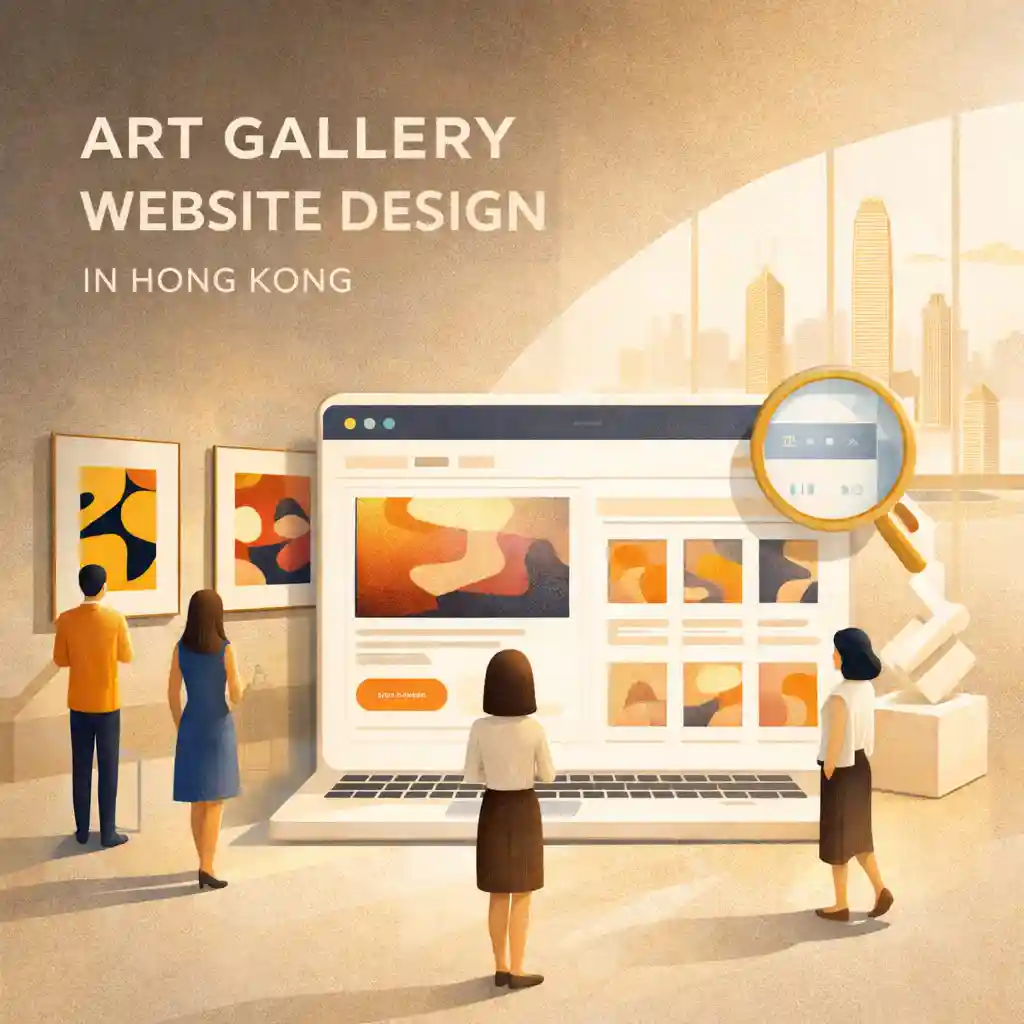
DOOD provides specialist art gallery website design services in Hong Kong for commercial galleries, independent artists, art consultancies, and collector-facing platforms. Our art gallery website design work addresses the sector's specific demands: high-fidelity artwork presentation, structured catalogue and edition management, online sales and inquiry flows, exhibition archive systems, and the kind of restrained visual design that puts the work rather than the interface at the centre of every page. We cover the full project scope — from UX design and information architecture through to WordPress build, WooCommerce integration, and post-launch support — so galleries and artists receive a platform that presents their work with precision and handles collector inquiries without friction.
Our art gallery website design approach recognises that the primary function of a gallery website is to make the work visible and the acquisition process straightforward. A collector or curator visiting the site needs to assess individual works in detail, understand availability and pricing where disclosed, and make contact or place an order with minimal steps. Every structural and technical decision we make is built around that sequence. Hong Kong galleries and artists rely on our art gallery website design practice to build platforms that serve both the presentation standards of the art world and the functional requirements of online commerce and inquiry management.
Art Gallery Website Design in Hong Kong
Visual Presentation and Site Architecture
Art gallery websites demand a higher standard of image presentation than most other site categories. Our art gallery website design process begins with a structured discovery phase covering the gallery's programme, artist roster, sales model, target audience, and the balance between presentation and transaction the platform needs to strike. We use this to build an information architecture that separates exhibition content, permanent collection or catalogue pages, artist profiles, and acquisition flows — so each content type has its own clearly defined section and URL structure rather than a single undifferentiated feed.
Visual design for gallery platforms is built around negative space and controlled typography. The interface must recede so that artwork photography fills the frame without visual competition from navigation elements, promotional banners, or decorative design choices. Grid systems for catalogue and exhibition pages are a core consideration in our art gallery website design work, built to accommodate works of varying aspect ratios without distorting proportions or forcing uniform cropping.
Our e-commerce website design practice informs how we structure individual artwork pages — each work is treated as a product with its own detail page, metadata fields, availability status, and inquiry or purchase action — but the visual treatment follows gallery standards rather than retail conventions. Responsive layouts maintain the same quality of presentation across desktop and mobile, where a growing proportion of collector research now takes place.
To request an Art Gallery Website Design Consultation, provide the following information:
- Gallery or artist type (commercial gallery, independent artist, consultancy, or other)
- Approximate number of works or editions to be presented at launch
- Whether online sales, inquiry-only, or a combination is required
- Languages required (English, Traditional Chinese, or both)
- Existing website URL if a redesign is in scope
Request an Art Gallery Website Design Consultation
Artwork Catalogue Management and Online Sales
A functional artwork catalogue requires more than a grid of images. Our art gallery website design builds structure each work as a discrete content entry with defined fields for: artist name, title, year, medium, dimensions, edition details where applicable, availability status, price or price-on-request designation, exhibition history, and provenance notes. This structured approach makes the catalogue filterable by artist, medium, period, or availability — and makes each individual work page indexable by search engines with its own descriptive metadata rather than relying on image filenames alone.
For galleries operating online sales, we integrate WooCommerce as the transactional layer with custom product templates that match gallery presentation standards rather than retail defaults. Payment gateway configuration covers standard international processors alongside local Hong Kong options.
For galleries that prefer inquiry-based acquisition rather than direct sale, we build price-on-request flows as structured functional forms — specifying exactly what information the collector provides, what confirmation they receive, and how the inquiry routes to the gallery team. This connects to our broader e-commerce development practice for galleries requiring more complex inventory management, multi-currency pricing, or collector account functionality. All transactional and inquiry interfaces across our art gallery website design builds carry full WCAG 2.1 AA compliance with complete ARIA labeling on interactive elements.
To request an Art Gallery E-Commerce or Inquiry Build Quote, provide the following information:
- Sales model required (direct purchase, price on request, or both)
- Payment methods required (credit card, bank transfer, FPS, or other)
- Whether edition tracking or limited-availability management is needed
- Whether a collector account or wishlist feature is required
- Existing inventory system or CRM to be connected
Request an Art Gallery E-Commerce or Inquiry Build Quote
Image Performance, Accessibility, and Search Visibility
High-resolution artwork photography is non-negotiable on gallery platforms, but it is also the primary source of page weight and load time degradation. Our art gallery website design builds address this directly through the following image delivery approach:
- WebP conversion with lossless fallback for older browsers
- Responsive image sizing delivering appropriately scaled assets per viewport
- Lazy loading on catalogue grids and exhibition archive pages
- CDN distribution to reduce latency for international collector audiences
- Core Web Vitals benchmarking before and after launch with documented performance deltas
WCAG 2.1 AA compliance is enforced across all builds. Every artwork image carries a descriptive alt attribute written to convey the visual content of the work to screen reader users — not a filename or generic label. Navigation, filter controls, modal lightbox interfaces, and inquiry forms all carry complete ARIA role, label, and state attributes. Keyboard navigation paths are tested end-to-end with correct focus management on overlay and zoom interfaces.
Schema.org structured data — including VisualArtwork, ArtGallery, and Person types for artist profiles — is implemented across relevant pages to support indexing by search engines and AI platforms. This structured markup approach supports our SEO services and ensures that art gallery website design decisions at the build stage create a durable search foundation for individual works, artists, and exhibition content.
Book an Art Gallery Website Performance and SEO Review
Ongoing Maintenance and Exhibition Updates
Gallery websites operate on exhibition cycles: new shows open, works sell and require availability updates, artist profiles expand, and archive content accumulates over time. Our post-launch support for art gallery platforms covers the following on a structured retainer basis:
- WordPress core, plugin, and WooCommerce security updates with pre-update staging testing
- New exhibition page builds and archive additions on agreed turnaround times
- Artwork availability and pricing updates across the catalogue
- Artist profile additions, biography revisions, and CV updates
- Performance monitoring and Core Web Vitals reporting on a monthly basis
- Security scanning, uptime monitoring, and incident response
We integrate ongoing gallery platform maintenance with our WordPress maintenance service, which handles the technical upkeep that gallery teams require without maintaining in-house web staff. For galleries considering a platform migration, significant catalogue expansion, or the addition of collector-facing account functionality as part of a broader art gallery website design upgrade, we provide custom WordPress development scoped to the specific operational and presentation requirements of the gallery — not adapted from a generic portfolio or retail theme.
Real-world implementation example: Our art gallery website design work for a Hong Kong art gallery required building a WooCommerce-based catalogue with e-commerce functionality that maintained gallery-standard visual presentation across the full artwork inventory. Individual work pages were structured with complete metadata fields, zoom-capable image delivery, and dual-path acquisition: direct purchase for priced works and a structured inquiry form for works sold on request.
Following launch, online inquiries through the catalogue increased by 67% compared to the previous site, and the gallery reported a measurable reduction in administrative back-and-forth due to the structured inquiry form capturing complete collector information at first contact.
Examples of art and gallery websites built through our art gallery website design practice:
- https://jpsgallery.com — Art gallery with e-commerce functionalities, WordPress WooCommerce
Quick Actions
This page supports the following actions for galleries and artists seeking specialist art gallery website design in Hong Kong. Select the one that matches your current requirement:
- Request an Art Gallery Website Design Consultation — for galleries or artists planning a new site or full redesign who need scoping, technology recommendations, and catalogue architecture advice
- Request an Art Gallery E-Commerce or Inquiry Build Quote — for galleries requiring online sales, price-on-request flows, edition tracking, or collector account functionality
- Book an Art Gallery Website Performance and SEO Review — for existing gallery platforms with slow image load times, poor mobile presentation, or weak search visibility for individual works or artists
- Book an Art Gallery Website Maintenance Retainer Scoping Call — for galleries requiring structured ongoing support for exhibition updates, catalogue changes, availability management, and security maintenance
Related articles: